
Dino profile
Stegosaurus
the dinosaur with plates on its back
Stegosaurus was a big dinosaur that ate plants. You can spot it by the two rows of plates on its back and the spikes at the end of its tail.
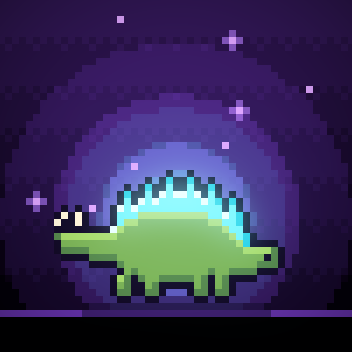
Its ID card
- Its name
- “Roof lizard”: at first, people thought its plates lay flat on its back, like the tiles of a roof. [1][2]
- Where
- Mostly in the western United States (Colorado, Wyoming, Utah). Some have also been found in Portugal. [1][2]
- Its weight
- About 3.5 tonnes, according to estimates. The biggest ones were maybe over 5 tonnes. [2]
- What it ate
- Low plants, like bushes. Its head probably stayed less than one meter above the ground. [1][2]
- Its family
- The stegosaurids, armored dinosaurs with plates and spikes. [1]
Plates on its back
It had between 17 and 22 flat plates and spikes, standing up in two staggered rows along its back. [1][2]
These plates were not attached to the skeleton: they were set in the skin. That's why they are often found separated from the rest of the fossil. [1]
What were they for? Nobody really knows. Maybe for impressing others, for recognizing other Stegosaurus, or for warming up and cooling down. Small grooves on their surface maybe held blood vessels. [1][2]
A spiked tail
At the end of its tail, it had two pairs of long spikes. It probably used its tail to defend itself against meat-eating dinosaurs, like Allosaurus. [1][2]
An Allosaurus tail bone has even been found with a hole in it, where a Stegosaurus spike fits perfectly. [2]
Its head was small, and its brain was roughly the size of a plum. [1][2]
In the past, people thought it had a second brain in its hips. Today, scientists think instead that this space was used for something else. [2]
Its discovery
Its first fossils are found by Arthur Lakes and H. C. Beckwith near the town of Morrison, in Colorado, in the United States. In 1877, American paleontologist Othniel Charles Marsh gives it its name. [1][2]
Later, a skeleton preserved in mud shows that the plates stood upright, alternating on each side of the backbone. [1]
In 2003, Bob Simon finds an almost complete skeleton in Wyoming, nicknamed Sophie: about 85% of the bones, or 360 bones. Since December 2014, you can see it at the Natural History Museum in London. [1][2]
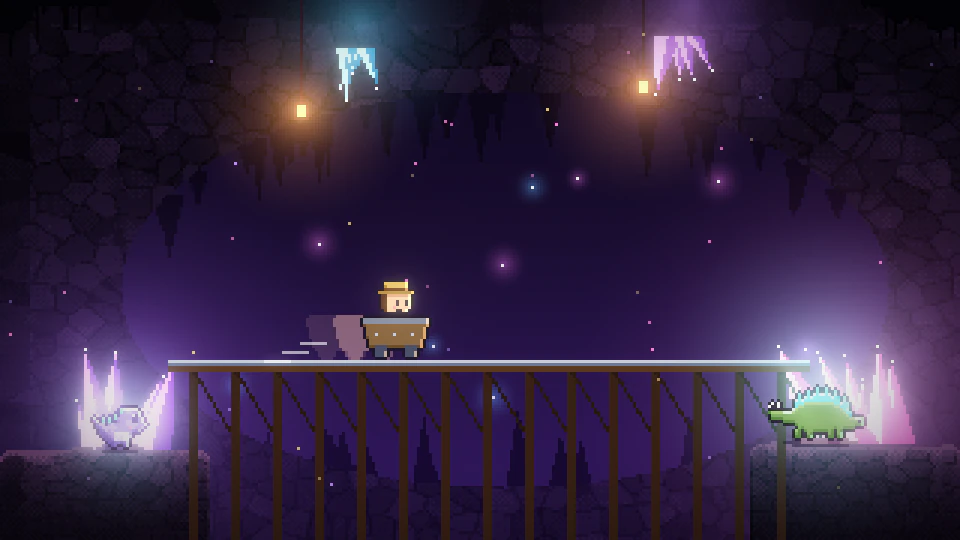
In Dino Cosmos
9 Crystal Mine
It helps you in its world. Its plates glow and light up the dark tunnels.
Sources
The information on this page comes from these sources:
- Stegosaurus, Dino Directory, Natural History Museum, London (accessed November 5, 2026).
- Stegosaurus, Wikipedia (English), and the publications it cites: Marsh 1877, Carpenter 1998, Carpenter et al. 2005, Escaso et al. 2007, Maidment et al. 2015, Paul 2016 (accessed November 5, 2026).