
Dino profile
Argentinosaurus
a giant known from just a few bones
Argentinosaurus was a sauropod, a long-necked dinosaur that ate plants. It is one of the largest known land animals, but only a few of its bones have been found.
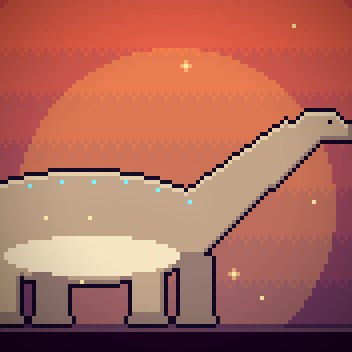
Its ID card
- Its name
- “Argentina lizard”, after the country where it was found. Its full name, Argentinosaurus huinculensis, also refers to the town of Plaza Huincul. [1][2]
- When
- In the Cretaceous, about 106 to 90 million years ago: scientists are still debating the exact age of the rocks where it was found. [1][2]
- Its weight
- Between about 65 and 80 tonnes, according to recent estimates. Since there are few bones, these numbers are still uncertain. [1][2]
- What it ate
- Tough plants. With its teeth, it stripped the leaves off branches. [1]
- Its family
- The titanosaurs, a group of sauropods: big long-necked dinosaurs that walked on four legs. [1]
A giant known from just a few bones
Only a few bones of Argentinosaurus are known: seven back vertebrae, part of the hip bones, pieces of ribs and a bone from the back leg, the fibula. [2]
Its vertebrae are enormous. One of them, once rebuilt, is almost 1.60 meters tall. [2]
Because its skeleton is very incomplete, its exact size is hard to know. Scientists compare its bones with those of other titanosaurs, like Patagotitan, and don't agree on which one was the biggest. [1][2]
Growing for a very long time
According to one estimate, each of its eggs held about 1 liter. At birth, the baby was probably no more than one meter long. [2]
It took many years to become an adult: about 15 to 20 years, according to estimates. And it kept growing for almost its whole life. [1][2]
It maybe used its long neck to graze close to the ground, or to reach leaves high up. [1]
It moved slowly: according to studies, its top speed was about 1.6 to 2 meters per second. [2]
Its discovery
In 1987, Guillermo Heredia finds a big bone on his farm, near Plaza Huincul. At first, he thinks it is wood that has turned to stone! He tells the town museum, the Carmen Funes Museum, which comes to dig it out. [2]
In 1989, paleontologist José Bonaparte leads bigger digs. Jackhammers are needed to get the bones out of the very hard rock. They all come from the same animal. [2]
In 1993, José Bonaparte and Rodolfo Coria give it its name. Its bones are kept at the Carmen Funes Museum, in Plaza Huincul, where you can see a rebuilt skeleton next to the real vertebrae. [1][2]
Sources
The information on this page comes from these sources:
- Argentinosaurus, Dino Directory, Natural History Museum, London (accessed November 5, 2026).
- Argentinosaurus, Wikipedia (English), and the publications it cites: Bonaparte & Coria 1993, Mazzetta et al. 2004, Hallett & Wedel 2016, Carballido et al. 2017, Paul 2019, Paul & Larramendi 2023, Sellers et al. 2013 (accessed November 5, 2026).